
Have you ever caught yourself approaching a completely unrelated situation the same way you would approach a problem at work?
I find myself doing this quite often. My first instinct when facing almost any problem is to break it down into an "if this, then that, else..." kind of thinking. I start considering different scenarios, possible outcomes, and what the next step would be depending on the decision made. Almost like writing pseudocode in my head without even realizing it.
And it got me thinking: Is this simply how I've always approached problems, or has my professional environment shaped the way I think?
There's actually a term for this: déformation professionnelle. It's the tendency to look at things through the lens of your profession, sometimes without even noticing it.
But how far does this go? Does what we do for a living actually affect who we are?
I see this in two ways: how we think and how we communicate.
How we think
People from different professional backgrounds can look at the same situation and approach it in completely different ways.
Take someone working in a technical field, for example. They're often trained to break complicated problems into smaller components, identify patterns, anticipate possible outcomes, and look for the most logical solution.
Someone with a creative background might approach the same situation differently. Instead of following a sequence of logical steps, they might start asking, "What if we tried something completely different?" They explore possibilities, connect unrelated ideas, and are often more comfortable with ambiguity.
Then you have people working in business, who might instinctively look at opportunities, value, and trade-offs. Or people whose work revolves around understanding human behavior, who might consider the different motivations and perspectives behind a situation.
Of course, these aren't rules. Not every engineer thinks the same way, and not every creative person approaches problems through intuition. But spending years in a particular environment reinforces certain ways of thinking.
And these habits don't necessarily switch off when we leave work. The engineer might find themselves troubleshooting everyday inconveniences, while someone in business might instinctively evaluate the potential return behind an ordinary decision.
At some point, the way we approach problems at work starts following us into our personal lives.
How we communicate
Two people can be discussing the same subject, sometimes even agreeing with each other, but still struggle to get their point across.
Think about a founder pitching their company to an investor. The founder might spend most of the conversation explaining the product, how it works, the features they've built, and the problems they've solved. Meanwhile, the investor might be thinking about the market size, scalability, business model, and potential returns.
They're discussing the same company, but they're looking at it through two different lenses.
Neither is wrong. They're approaching the conversation with different priorities, shaped by what their respective roles require them to focus on.
Over time, we also start adopting the language of our professions. The terminology we use, the details we prioritize, and even the way we structure an argument become second nature.
Without realizing it, we can start communicating with people outside our professional circles as if they're approaching things from the same perspective we are.
Sometimes what we perceive as a communication problem isn't really a disagreement. It's just two people processing and expressing the same idea differently.
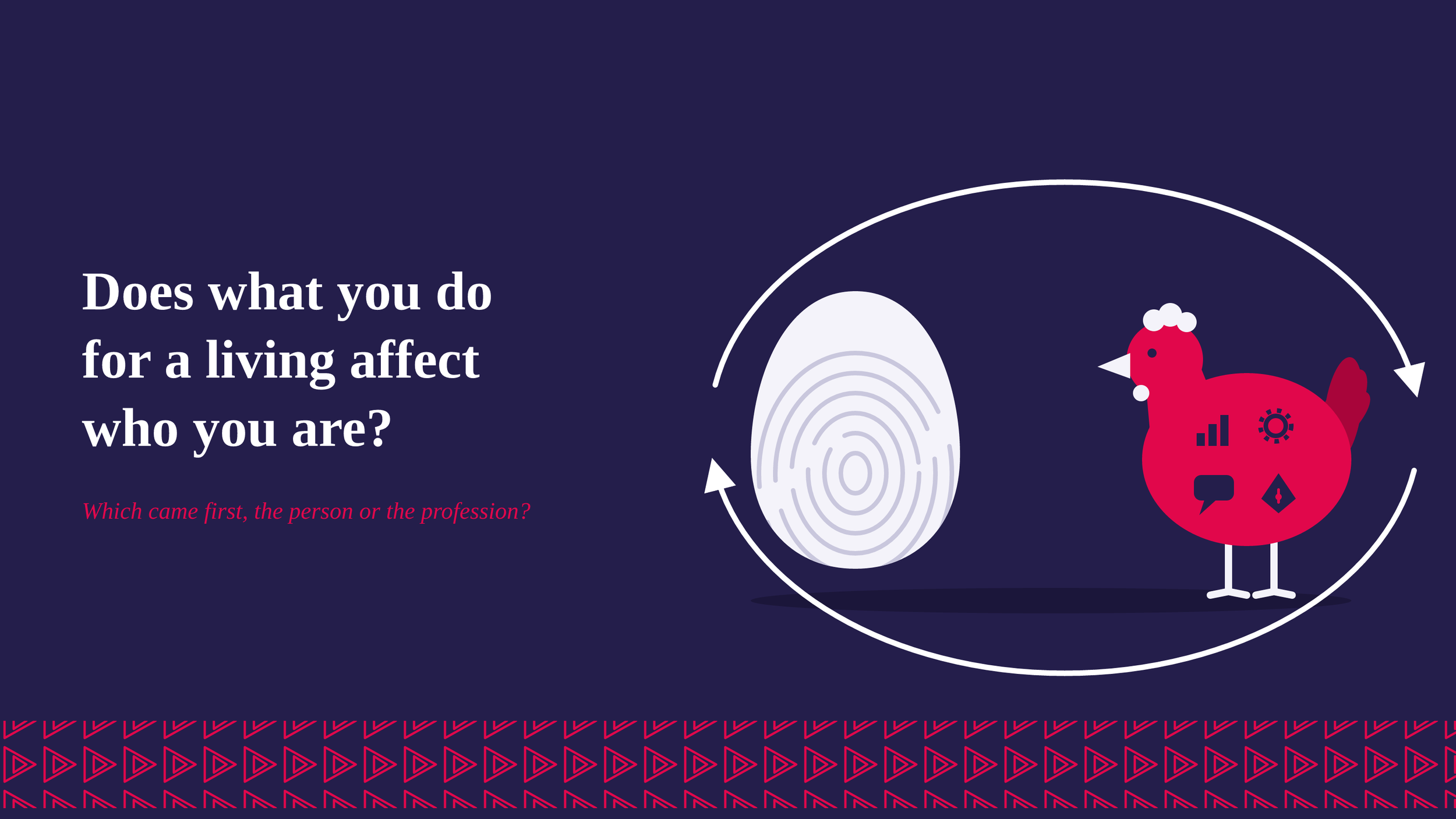
So, which came first?
But here's another side of the discussion: Are we shaped by our professions, or do our existing personalities influence the professions we choose in the first place?
Maybe people who naturally enjoy structure, logic, and problem-solving are more likely to pursue technical careers. Maybe people who enjoy understanding human behavior gravitate towards roles that involve working closely with others.
In that case, our professions aren't necessarily creating these characteristics. They might be reinforcing something that was already there.
Over time, the relationship works both ways. We choose careers that align with certain parts of our personalities, and those careers continue to develop and strengthen those same characteristics.
It's a continuous cycle, and I don't think we can easily separate the two.
The blind spot
The more interesting part is what happens when we become too accustomed to seeing things through that one professional lens.
When you spend years approaching problems in a certain way, it's easy to assume that your way of thinking is the most logical or obvious one. You might even struggle to understand why someone else would approach the same situation differently.
But what if the thing you're overlooking is exactly what someone else is trained to notice?
Someone who is used to breaking things down might miss the bigger picture. Someone who focuses on the bigger picture might overlook the details. Someone who prioritizes numbers might overlook the human element, while someone focused on people might overlook the commercial implications.
Our professional backgrounds give us certain strengths, but they can also create blind spots.
That's why interacting with people from different backgrounds is so valuable. They challenge assumptions we didn't even know we had and introduce ways of looking at things that we might never have considered on our own.
Does what we do for a living affect who we are?
I believe it absolutely does.
We spend a significant part of our lives working, solving problems, communicating, and making decisions within a particular environment. It would be unrealistic to think that all of this has no effect on our personalities or the way we see the world.
At the same time, who we are influences the paths we choose and the environments we gravitate towards.
My instinct will probably always be to branch a problem into if/else. The goal is to notice when someone else is asking a question I hadn't thought to ask.