
Market vs Founders: Rethinking What Really Matters in Startups
Today, I came across Marc Andreessen’s blog post, “The Only Thing That Matters,” and it felt like it was the first time I read it.
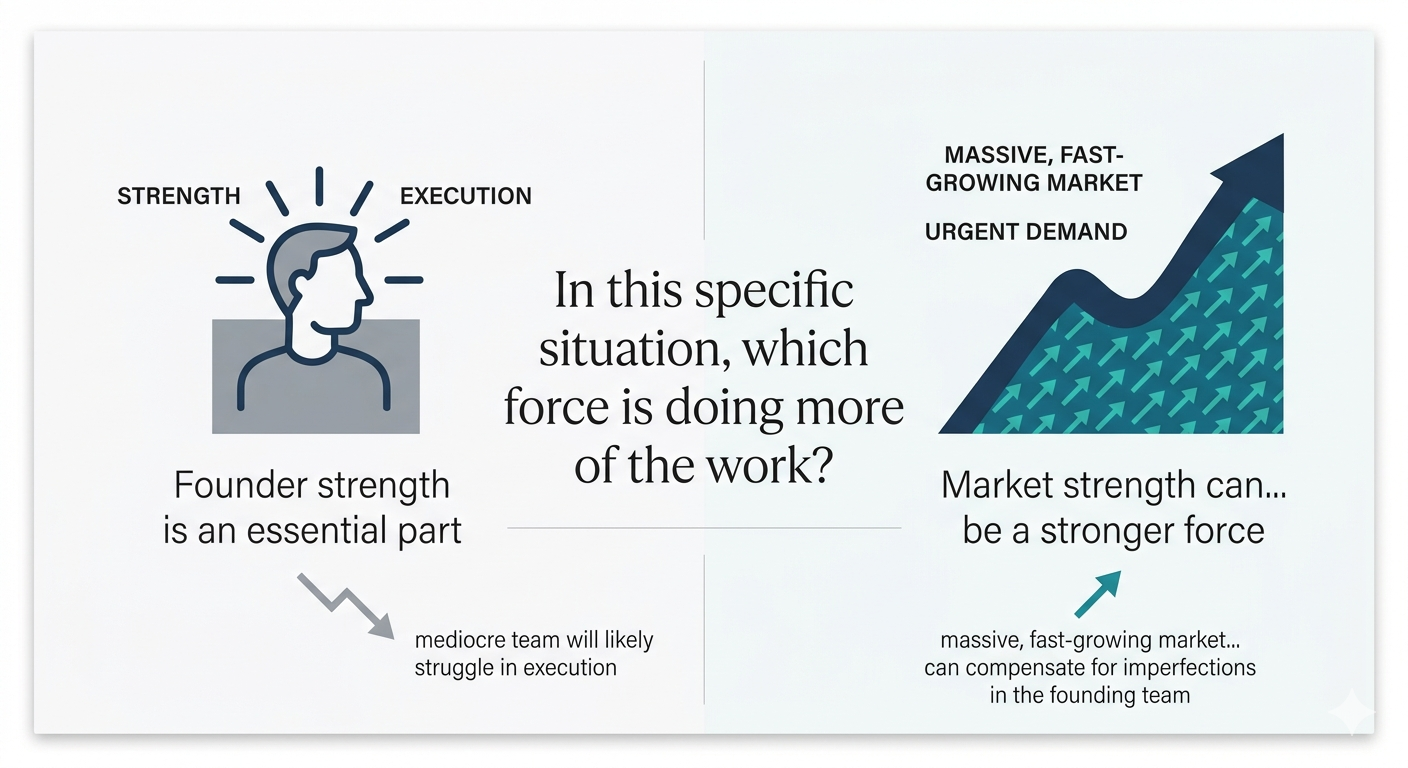
I have always believed that founder strength is an essential part of evaluating any startup we take seriously. Because of this, I would often pass on deals even when everything else looked compelling if I wasn’t convinced by the founders.
At the same time, I’ve never really understood internal excitement around deals where the market is strong, but the founding team feels mediocre.
To me, the logic has always been simple: even if the market is large, growing, and has a clear pain point, a mediocre team will likely struggle in execution. And if execution fails, the startup fails regardless of how good the market is.
My concern has always been that if a strong founder enters the same market later, they will almost certainly outperform and eventually dominate, making the earlier, weaker team irrelevant.
While I still believe this concern is valid, I’ve started to question whether this framework is incomplete.
If we think only in terms of “great founders or nothing,” we risk systematically missing out on great markets. We end up waiting for the “perfect” combination, great founders entering a great market, while ignoring that sometimes a less exceptional team can still build a successful company simply because the market itself is strong enough.
In other words, a massive, fast-growing market with real, urgent demand can sometimes compensate for imperfections in the founding team. When a problem is painful enough and demand is strong enough, even a not-perfect product from a not-perfect team can still find significant traction.
This doesn’t mean founders don’t matter; they absolutely do. But it suggests that market strength can, in certain cases, be a stronger force in determining outcomes than we typically assume.
Ultimately, the question may not be “market or founders,” but rather: in this specific situation, which force is doing more of the work?
