New Asset Class: Cashflow Capital
The future isn’t only unicorns. It’s also upgraded “lifestyle” businesses that distribute cash, as AI makes software cheaper.
The Old Map: Lifestyle Vs. High Growth
Venture capital trained us to see the startup world in two buckets: “lifestyle” versus “high growth.”
Lifestyle, in the VC sense, is a business that can be great, profitable, and durable, but not designed to scale exponentially. Think: a restaurant group, a clinic, a factory, a local logistics company, a construction subcontractor, a managed IT services shop, a car dealership, a marketing agency, a call center, a local real estate brokerage, a specialty retailer, a training company, a small manufacturing line. Real businesses. Often owner-operated. The kind that can give a family wealth, but rarely becomes a venture outcome.
High growth is the other end of the spectrum: a technology company built to scale aggressively, usually because it created a new product or a new category, or because it rode an emerging technology wave before anyone else. That growth can come from inventing a new software or hardware product [Apple], creating a new market by mastering a new technology shift [Google], building a new core compute platform and enabling layer [NVIDIA], commercializing a breakthrough capability into a new interface for work [OpenAI], dethroning incumbents by rewriting the rules of distribution and convenience [Amazon], turning a messy offline market into a liquid network [Uber] [Airbnb], or building the infrastructure layer for private markets that others depend on [Carta].
That two-bucket model used to be helpful. Now it’s limiting. Not because VC is wrong, but because technology is changing the shape of what a “good company” looks like.
The Acceleration Effect: Why The Middle Is Exploding
We’re living through an acceleration in tool creation and tool commoditization that’s unprecedented. Every year, more capabilities become cheaper, easier to replicate, and faster to deploy. As that happens, something weird, and exciting, emerges in the middle: a rising generation of companies that look like startups on the outside, but behave like cashflow machines on the inside.
This is where Cashflow Capital comes in.
The In Between New Asset Class: Cashflow Capital, And What It Actually Is
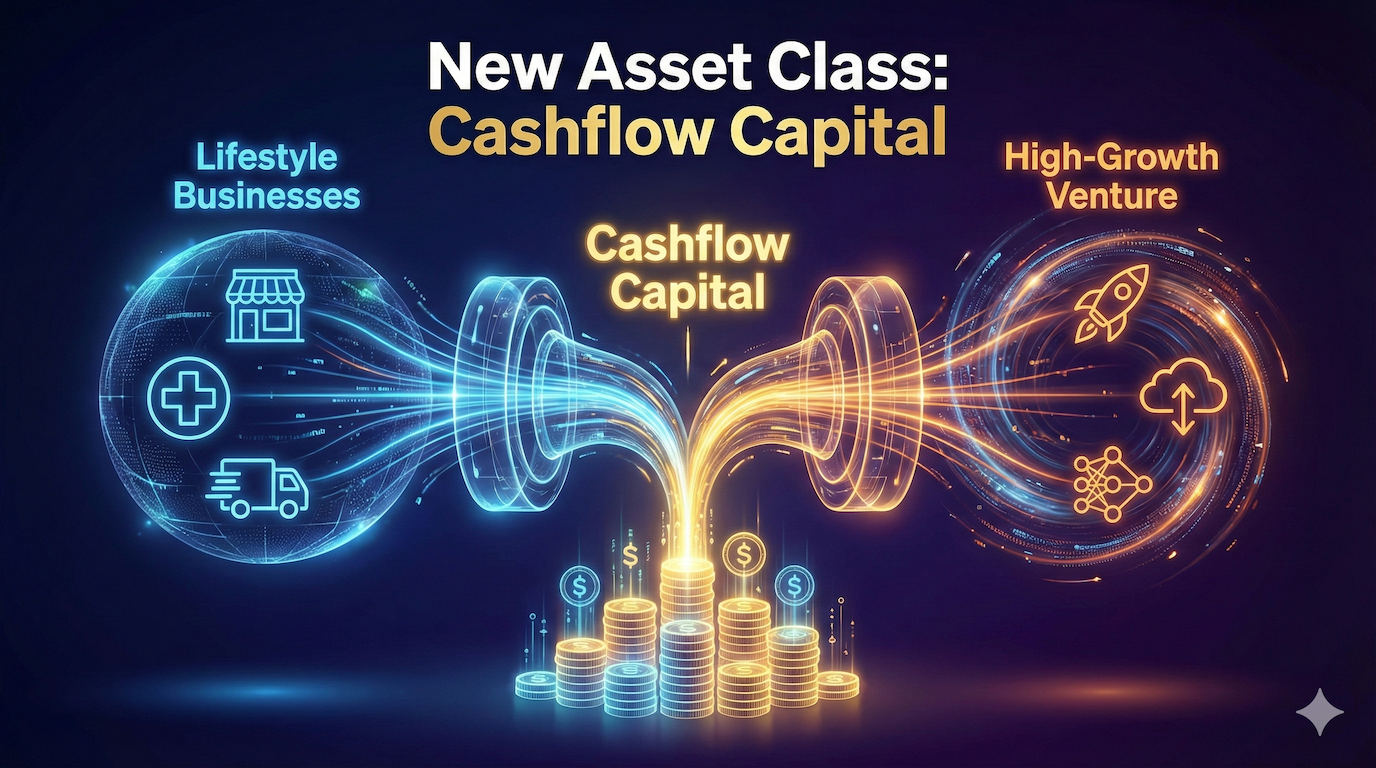
Cashflow Capital is the category that sits between venture and lifestyle. It’s not chasing global dominance. It’s chasing profitable dominance in a lane, a city, a country, a vertical, a network, a distribution channel, and it wants to reach profitability fast, stabilize, and then distribute cash to owners. It’s the logic of a “lifestyle business,” upgraded by software, automation, and AI, but built with a sharper financial mindset than traditional small businesses ever had access to.
You can see it already, especially outside Silicon Valley, and increasingly inside it too.
A local stock trading app might never become the next Robinhood, and that’s fine. In a single market, with the right product, trust, education, and distribution partnerships, it can still become a better business than the best traditional brokerage in that same market, with fewer employees, better unit economics, and a modern customer experience. A fractional real estate investment platform doesn’t need to “go global” to work; it needs deal flow, compliance, investor trust, and a repeatable underwriting and servicing engine. A local ride-hailing app doesn’t need to beat Uber everywhere; it can win a city by partnering with taxi fleets, hotels, airports, universities, and even municipalities, and by focusing on operational excellence rather than global conquest. A WhatsApp partner agency can become a modern revenue engine for thousands of SMEs by building repeatable commerce and customer support workflows. An AI automations services company can replace internal ops teams in mid-market companies and become highly profitable faster than most SaaS startups, because it sells outcomes, not seats.
These businesses are not “small.” They are simply not built for the VC game.
The Underlying Engine: Commoditization Changes The Edge
The deeper reason this category is emerging is commoditization. Every breakthrough goes through an arc: first it’s hard and rare, then it becomes productized, then it becomes cheap, then it becomes invisible infrastructure. The internet did that. Payments did that. Cloud did that. And now AI and automation will do that to an absurd number of software categories.
Uber is a perfect example of how the edge evolves. When ride-hailing first appeared, the matching, tracking, routing, and payments integration felt like magic. Today, there are countless local ride-hailing startups, taxi fleets with apps, and entire white-label ride-hailing stacks sold as SaaS. Uber is still dominant in many places because of brand, network liquidity, and operational depth, but the technology itself is no longer the edge. The edge became distribution, trust, and network behavior.
And that’s the point: when the technology becomes easier, strategy becomes the differentiator.
A decade ago, the cost and difficulty of building certain tech meant only a handful of teams could even try. Today, many of these products can be built quickly using modern tools like Replit or Lovable, and Make or n8n, with smaller teams, and in some cases with AI-assisted development. That doesn’t guarantee success, but it radically expands the surface area of what’s buildable, and how quickly a company can reach “good enough” product.
The “Upgraded Lifestyle Business” Era
So what happens? Lifestyle businesses get upgraded faster than ever. Or more precisely: new businesses get created that would have been lifestyle businesses in the past, but now have software-grade efficiency and margin structure.
This creates a new investing opportunity that most traditional capital providers aren’t structurally designed to capture.
Banks, in theory, should love these businesses. They are often revenue-generating, fast-to-profit, and operationally measurable. But banks are slow, slow risk models, slow product cycles, slow underwriting innovation. Many banks still struggle to finance anything that doesn’t fit a 20-year-old template, especially if the business looks “techy,” even when it’s already producing cash. So they miss it.
Venture capital, on the other hand, often ignores it because the upside doesn’t look like a power-law outcome. A local trading app won’t become a $50B company. A city-based ride-hailing network won’t dominate the world. A WhatsApp partner agency won’t IPO. The venture lens sees these as “not big enough,” which is another way of saying: “not shaped for our fund economics.”
But that doesn’t mean they aren’t great investments. It means the capital model is mismatched.
Who The Lp Is In This World
Cashflow Capital is for investors who aren’t hunting for a single massive liquidity event ten years from now. They’re hunting for annual yield and durable profitability. These LPs don’t want to wait for hope to compound; they want cash to compound. They want distributions. Dividends. Predictability. And they’re willing to trade some upside multiple for a clearer path to return.
Why 2/20 Doesn’t Fit, And What Fits Better
This is why the classic 2/20 venture model doesn’t fit neatly here.
If the primary value is ongoing profit distributions, you can’t design the fund around “exit-only carry.” There may be no exit. Or exits may be optional and opportunistic, not the primary plan. The model needs to align incentives with cash actually returned, not paper marks, not narrative momentum, and not a theoretical multiple.
A more natural structure looks like this: a modest management fee while the portfolio is being built and operationalized, then a declining fee as the platform matures, combined with a performance fee based on distributed profits (and ideally only after a hurdle). In plain English: the manager gets paid when LPs get paid, and the fee mechanics don’t pretend we’re waiting for an IPO that may never come.
Where Cashflow Capital Invests
The investment stage also matters here. Cashflow Capital can invest at different stages, but its “sweet spot” is usually post-product and post-revenue, with clear unit economics and a believable path to profitability within 12–24 months. This is where the model becomes repeatable: companies that don’t need venture narrative to survive, and don’t require another funding round to justify their existence. They can become self-sustaining machines, and then owners can choose whether to keep compounding or pursue optional liquidity.
You can call this “small private equity,” but that label misses the point. Private equity typically buys maturity, optimizes it, leverages it, and exits it. Cashflow Capital is often earlier than that, more product-driven than that, and more founder-built than that. It’s closer to venture in how companies are created, but closer to income investing in how returns are delivered.
In other words: it’s a new lane.
The Contrarian Conclusion
And I think it’s going to become one of the most important lanes in the next decade, especially in emerging markets and mid-sized economies where “local winners” can be enormous businesses without ever needing global scale. When you combine cheaper software, faster execution, and AI-driven automation, you create a new type of company: one that reaches profitability sooner, runs leaner, and can distribute cash to owners earlier than the venture world is used to.
The contrarian conclusion is simple: the future isn’t only the frontier. It’s also the industrialization of the frontier.
Venture capital will always matter. We still need the companies that invent the future, the ones that create new platforms, new markets, and new technological primitives. But we should stop pretending that’s the only game worth playing.
There are two games now.
One game is to invent the future.The other is to take what’s becoming possible, package it into profitable businesses, dominate a lane, and distribute the cash.
That second game deserves a name. Cashflow Capital is my name for it.
This new asset class: Cashflow Capital (CC) can be added to Private Equity (PE), Venture Capital (Vc), Venture Debt (VD), and Revenue-Based Financing (RBF).
And if you’re building or investing in this category early, you’re not “late to venture.” You’re early to a new asset class, one that doesn’t rely on exits to create wealth, because it creates wealth every year.