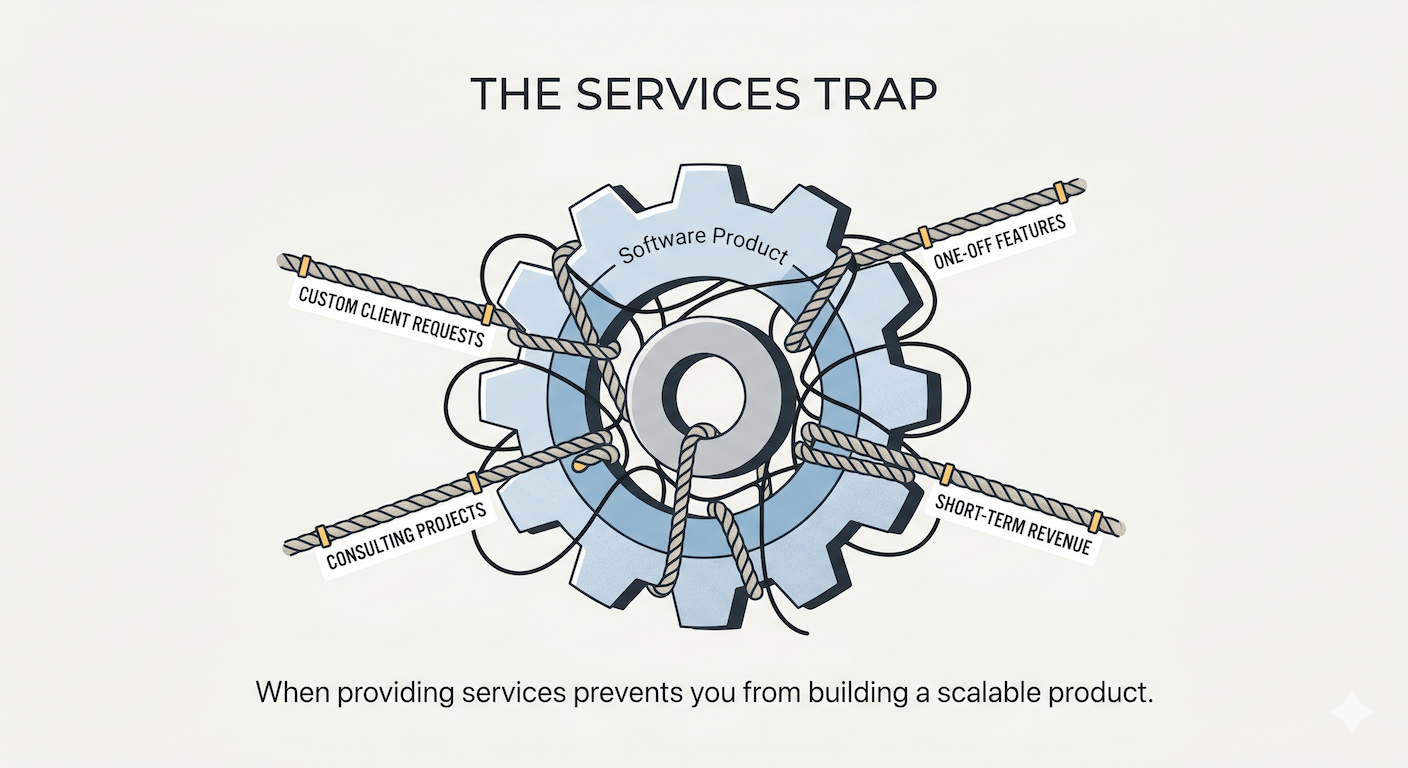
Trap Alert: “We’ll Start as a Service, Then Productize Later”
I’ve heard this pitch from founders many times. And honestly, on the surface, it sounds very reasonable. “We’ll start as a service business, work closely with a few paying clients, really understand the problem, refine the solution, and then turn that into a scalable software product.”
In theory, it sounds smart. In practice, sometimes it works. But many times, founders get stuck somewhere in the middle.
Not because they are bad founders.
Not because the idea is bad.
But because the path from services to product is much harder than it sounds when you say it in one sentence.
To be clear, I get the appeal. You need cash. You need to bootstrap. You need real customer exposure before building too much. I’m not against this approach in principle.
I just think founders often underestimate how dangerous it can be. Here are a few reasons why:
1) You can end up in contract slavery
This is probably the biggest one.
What starts as “a few clients to help us learn” can quietly become a business that is fully controlled by client demands.
Now you’re not really building your roadmap anymore. Your clients are.
Each client wants something slightly different.
One wants a custom workflow.
Another wants a special integration.
Another wants a reporting dashboard “just for now.”
Another wants white-labeling.
Another wants support that goes way beyond what you intended.
And because they are paying, it becomes very hard to say no.
So instead of building one scalable product, you start building custom pieces for different customers. Your team gets pulled into delivery mode. Your roadmap gets fragmented. Your product vision gets delayed quarter after quarter because revenue today keeps winning over scale tomorrow.
That’s what I mean by contract slavery.
You are technically generating revenue, which is great. But you may also be giving up the freedom to build the actual company you originally wanted to build.
And the scary part is that this can happen gradually. It doesn’t feel like failure. It feels like progress.
2) The cash can seduce you into a comfort zone
This one is more subtle.
Services can produce real cash much earlier than product can.
A product company often feels painful in the beginning. You spend a lot before you make much. You deal with uncertainty, low initial traction, and a lot of delayed gratification.
A service business can feel much more rewarding much faster. You sign clients. Money comes in. The business starts to feel real. You might even become profitable earlier than many startups.
And there is absolutely nothing wrong with that.
In fact, if your real goal is to build a profitable lifestyle business, that can be a beautiful outcome.
But if your stated goal is to build a venture-scale company, this comfort can become dangerous.
Because once the services engine starts paying salaries, rent, and maybe even founder income, the urgency to take product risk starts going down. The messy, uncertain, expensive work of building something standardized and scalable becomes easier to postpone.
You start saying things like:
“We’ll focus on product after this next contract.”
“Let’s just close these two clients first.”
“Let’s stabilize cash flow, then we’ll invest in the platform.”
And suddenly two years pass.
You still talk like a product company. But operationally, culturally, and financially, you’ve become a service company.
Again, maybe that’s totally fine. But it’s important to be honest about it.
3) Talent drain is real
The kind of talent that helps build a real product company is not always the same talent that thrives in a custom client-service environment.
Great product builders usually want to work on reusable systems, not endless one-off requests. They want to improve the core product, not keep patching edge cases for individual customers. They want leverage.
If your company starts behaving like a client delivery shop, strong product and engineering talent can get frustrated.
Some of them leave.
Some mentally disengage.
Some adapt, but in a way that shifts the company culture away from product thinking.
Over time, you may attract more implementation people than product people. More account-management energy than platform energy. More short-term responsiveness than long-term architecture.
None of that is bad in itself. It just may not be the team composition that builds a venture-scale software company.
4) You can confuse custom demand with product-market fit
Just because a few customers are willing to pay you for a heavily customized solution does not mean there is a scalable product there.
Sometimes founders mistake “people paid us” for “we have validated the product.”
But what the customers may really be paying for is:
your flexibility
your hands-on service
your willingness to customize
your personal involvement
your ability to act like an outsourced team
That’s very different from people wanting a repeatable product that works with minimal customization.
So founders can end up with false confidence.
They think they have validated a market, when in reality they may have validated a consulting relationship.
That distinction matters a lot. Because one scales through code, product design, distribution, and repeatability. The other scales through people, time, and more service capacity.
Very different business models. Very different outcomes.
So what am I saying?
Not “never do services.”
Not “this model never works.”
And definitely not “founders should feel bad if they started this way.”
Sometimes founders have no choice. Sometimes services are the bridge that keeps the dream alive. Sometimes the service path genuinely leads to a great product company.
But I do think this path should be treated with much more caution than it usually gets.
Because it is very easy to say:
“We’ll start with services and then productize.”
It is much harder to actually escape the gravity of services once the money, clients, habits, and team all start organizing around it.
Maybe the better question for founders is not:
“Can we start with services?”
Maybe it is:
“How do we make sure services don’t quietly become the destination?”
That means being brutally honest about things like:
how much customization you allow
whether you are building reusable product or just client work
whether your roadmap is still yours
whether your best talent is excited or drained
whether you are building a startup or just a good small business with startup language around it
And again, there is nothing wrong with a good small business. The problem is only when founders say they want one thing, but structure the company in a way that leads somewhere else.
I’d love to hear other views on this, especially from founders who actually made the jump successfully from services to product.
Because yes, it can work.
I just think many more get trapped there than we openly admit.