
Is SaaS Ending in the Age of AI?
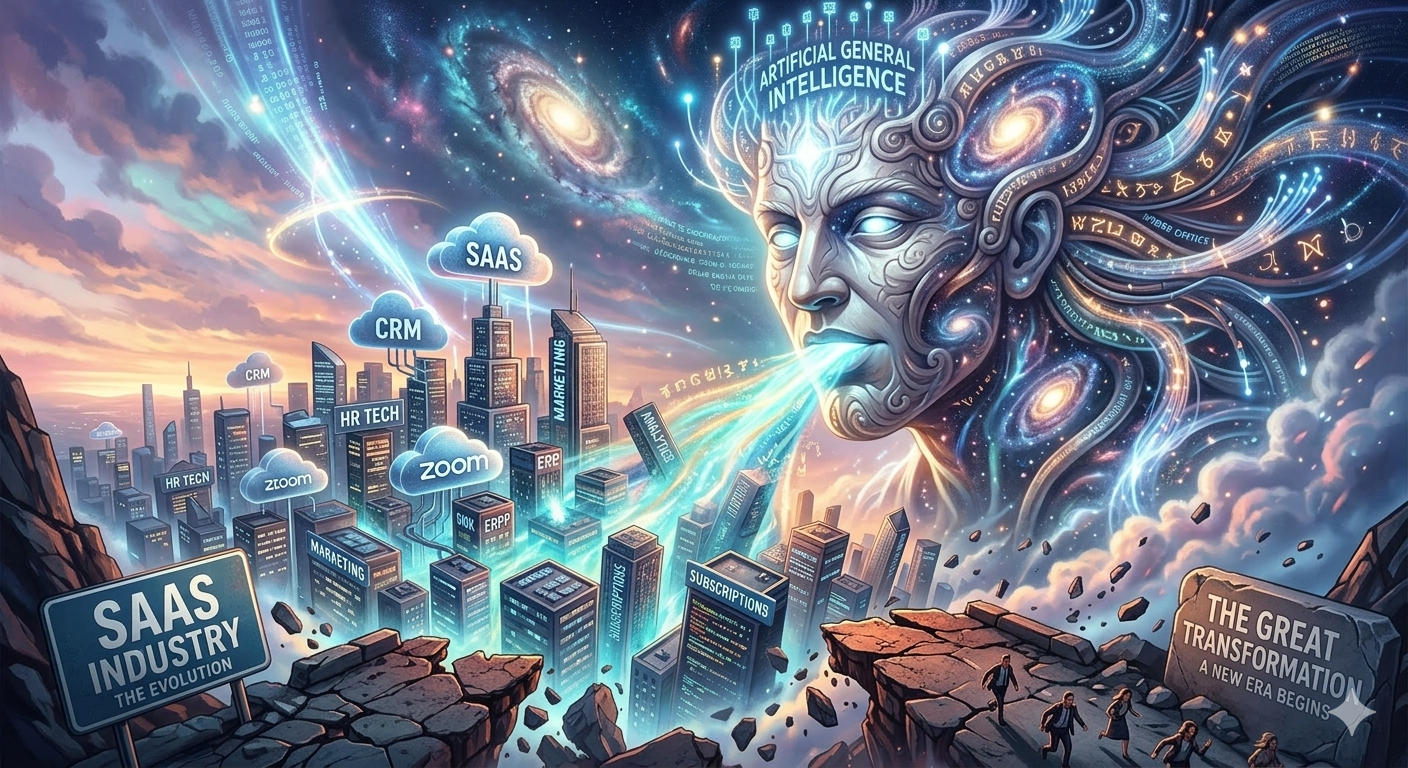
The last decade of enterprise software was defined by SaaS. Companies subscribed to an expanding stack of tools, CRMs, project management platforms, ERPs, and many others. Each is designed to handle a specific part of their operations.
But this model assumes something important: that humans are the ones operating the software.
Today, that assumption is being challenged. With the rise of AI agents, workflows can increasingly be automated, orchestrated, and even built dynamically by AI.
This shift raises a fundamental question for the software industry:
Does the rise of AI signal the beginning of the end for traditional SaaS?
This question recently moved from theoretical debate to market reality.
Over the past month, many SaaS companies experienced sharp stock declines, triggering a term that started circulating across the tech ecosystem: the “SaaSpocalypse.”
The selloff reflects a growing concern among investors: if AI can automate workflows, what happens to traditional SaaS products?
The Old Model: Humans Adapt to Software
Traditional SaaS products are designed around structured workflows.
The product defines:
How data is stored
How processes move between stages
How users interact with the system
Users operate inside those predefined boundaries.
For example, a CRM defines pipelines, deal stages, and reporting structures. You can customize some parts, but the underlying system logic remains fixed.
This model worked well because humans were the operators of software.
Employees manually executed the workflow: reviewing documents, updating records, scheduling calls, sending emails, and preparing reports.
But AI changes the operator.
AI Agents Can Execute Entire Workflows
AI agents introduce a different paradigm.
Instead of humans performing each step, AI can execute entire workflows autonomously:
reading documents
making decisions
sending emails
updating systems
generating analysis
In this new paradigm, the core question becomes:
Can your software be easily orchestrated by AI agents?
And surprisingly, many SaaS tools struggle here.
A Simple Example: Venture Capital Workflows
Take a typical venture capital workflow.
A firm receives startup pitch decks through its website. The process usually looks something like this:
The submission is captured in a CRM
The investment team reviews the deck
If interesting, a screening call is scheduled
Initial analysis is done (market sizing, competition)
The team requests access to the data room
The team reviews the materials
A full investment memo is written
This process involves many repetitive steps that require manual work.
But with AI agents, much of this workflow could be automated.
An AI system could:
Read the pitch deck and generate an initial screening recommendation
Automatically send a pass email or schedule a screening call
Summarize the call
Generate market sizing estimates
Map the competitive landscape
Analyze the data room
Draft the investment memo
An AI-driven workflow could assist with much of the pipeline, augmenting human effort at each step.
But implementing this inside most horizontal SaaS tools today is surprisingly difficult.
The Problem With Horizontal SaaS
Many horizontal SaaS tools, such as CRMs, project management tools, and ERPs, were not designed for AI-native workflows.
They were built for humans interacting through interfaces, not AI agents orchestrating processes.
As a result, companies often face:
Rigid workflow structures
Limited flexibility in automation
Friction when trying to orchestrate end-to-end processes
This is where vibe coding starts to become powerful.
If AI can generate software quickly, companies may find it easier to build their own internal tools tailored to their exact workflows rather than forcing their processes into rigid SaaS products.
And this is where the threat to SaaS becomes more visible.
Vertical SaaS May Be More Defensible
However, not all SaaS is equally exposed.
Vertical SaaS (software built specifically for a single industry) may be more resilient.
These products often embed deep industry expertise and complex regulatory requirements.
Examples include:
Healthcare systems like Epic Systems or Veeva Systems
Financial infrastructure platforms like Temenos
Restaurant operating systems like Toast
E-signature software like DocuSign
Most of these sectors involve strict regulation, complex integrations, and accumulated industry-specific knowledge.
In these environments, building a replacement through vibe coding is far more difficult.
So… Does the SaaS Era End?
Probably not.
But the nature of SaaS may change significantly.
Horizontal SaaS products that mainly provide generic workflows could face increasing pressure as AI makes custom software easier to build.
Meanwhile, vertical SaaS companies that embed deep industry expertise and regulatory infrastructure are likely to be less threatened by AI replacement.
Closing Thought
SaaS transformed how companies buy and use software. AI may transform how that software is operated. And as this shift unfolds, the software industry may move from a world of tools that humans click to systems that intelligence can run.
