
The Joke At Our Sadu Meeting That Made Us Rethink GEO (The Term You'll Be Hearing Everywhere This Year)
It was one of my first weekly meetings at Sadu Capital. Everyone around the table, the usual start of the week, and Aljawhara — one of our investment team — was sharing her screen and walking us through the overview of the week. Markets, deals, what moved, what to watch. She is the one who reads everything before the rest of us do, so her screen is basically the week, condensed.
Somewhere in the middle of it, one of our partners dropped a passing comment. Half a joke, really:
"Look how many tabs Aljawhara has!! But you know, comparing to her first days here, this is a mercy."
Everyone laughed. Aljawhara laughed too and kept going with the update, and the meeting moved on in five seconds. I did not move on. I kept thinking about that line for the rest of the week.
So what exactly changed?
Why the tabs matter
A browser tab looks like nothing. But twenty of them is a person doing the last mile of the search engine by hand. Open ten links, close six, skim four, assemble the answer yourself.
Google never gave anyone an answer. It gave you a list of places where the answer might be, and you did the rest of the work for free. The tabs were the work.
That work is disappearing. The assistant reads the ten pages, drops the six that are useless, and hands back one answer with the sources at the bottom. And every one of those tabs used to be a visit — an ad impression, a lead, a reason for a marketing budget to exist. The answer arrived. The traffic did not. People call this zero click.
So the joke was not about tabs. It was about a behaviour that changed inside our own office, without anyone deciding it or announcing it. And it sent me back to the GEO companies already sitting in our pipeline, which I had been reading lazily: SEO with a new name, a dashboard counting ChatGPT mentions, probably a feature inside someone's marketing platform one day.
So what is GEO, in plain words
GEO stands for Generative Engine Optimization. Some call it AEO, some still call it AI SEO. The name is not settled yet, which by itself tells you how new this is.
The easiest way I explain it to people:
SEO = make sure your page ranks high on the results page, so the person clicks you.
GEO = make sure your brand is what the model mentions, recommends and cites when it answers, because there may be no results page at all.
Think of a supermarket. SEO was fighting for shelf position, where the customer still walks the aisle and picks. GEO is the customer asking one employee: "what should I buy?" No aisle. One sentence, and either your name is in it or it is not. Second place used to mean less traffic. Now it means none.
And the work moved outside your website. SEO was what you control: keywords, speed, backlinks. GEO is what reviews and Reddit threads say about you, and whether the model understands your category in your language
Then I looked at the numbers, and they are not small
I do not want to drown this in statistics, so three numbers only.
In the first four months of 2026, about 68% of US Google searches ended without any click. Two years before it was 60%. In simple terms: for every 1,000 searches, around 276 clicks now reach the open web. It used to be 374. (SparkToro with Similarweb data.)
When an AI answer sits on top of the page, the first organic result loses roughly 58% of its clicks. (Ahrefs.) The ranking did not change. The traffic did.
The SEO industry is around $84–108 billion a year depending which report you trust. That is the size of the budget built on the assumption that attention arrives through a link.
So the question is not "is this real". The question is where that money goes when the link stops arriving.
The rethink
The correction was not "GEO is bigger than I thought". It was that we had the whole category filed in the wrong box. These are not marketing tools. They are the measurement layer for a discovery channel that is being rebuilt while everyone is still looking at the old one. Different question, different ticket size, different diligence.
And once you see it that way, you cannot stay at the pitch deck level. You have to open the product.
So we tried to measure it ourselves
Before judging anyone's tool, we did the simple version by hand.
We took a set of questions a real customer would ask in a category we know. Not brand questions, buying questions. "Best X for Y", "which company should I use for Z". Then we asked the assistants directly and wrote down what came back: who is mentioned, in which order, which sources are cited.
Then we ran the same prompts again in different ways. And this is where it got interesting, because the answers did not match.
Same question, different answer depending on how you ask it, where you ask it from, and whether you are asking the model or the product.
That is when I understood this is not a reporting problem. It is an architecture problem.
Two ways to ask, two different answers
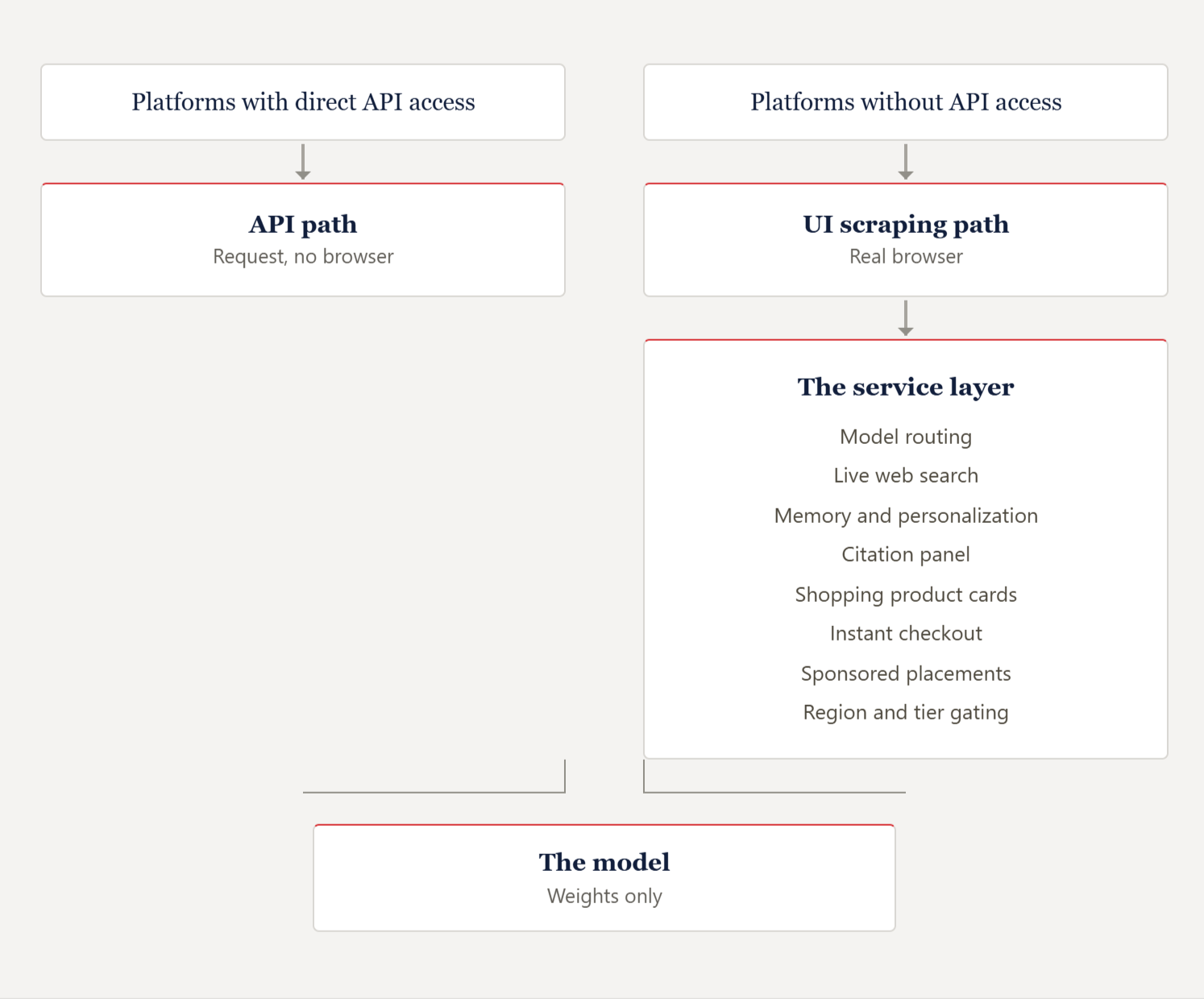
One word first, because not everyone works with it. An API is the back door that developers use to talk to a model directly, machine to machine. No app, no screen. You send a question in, you get text back.
So there are two ways to ask a model what it says about your brand.
Path one: through the API, the back door. You send the question straight to the model. Cheap, fast, easy to run thousands of prompts.
Path two: through the app, like a normal customer. You open a real browser, logged out, type the question, and read exactly what a person would see.
The simplest way I can put it: the API is like calling the kitchen and asking the chef what is in the dish. The app is the plate that actually arrives at your table — after the waiter, the menu of the day, the promotion they are pushing, and the portion they serve in your country.
They are not the same thing. The API gives you the model and almost nothing else. But the interface your customer uses sits behind a whole service layer: model routing, live web search, memory and personalization, the citation panel, shopping cards, instant checkout, sponsored placements, and region and tier gating.
Every one of those layers changes the answer.
So a tool measuring through the API is telling you what the model thinks. Not what your customer is being shown. For a brand, only the second one is real.
And the second thing: where you measure from. Answers are gated by region. A brand can be recommended in one market and completely invisible in another. A tool that does not pin its measurement to a country simply cannot see this. For our region, that is not a small detail. That is the opportunity.
Where I think the value sits
Map the full workflow and it breaks into seven stages: understand the brand, measure, analyse, recommend, execute, earned media, attribute.
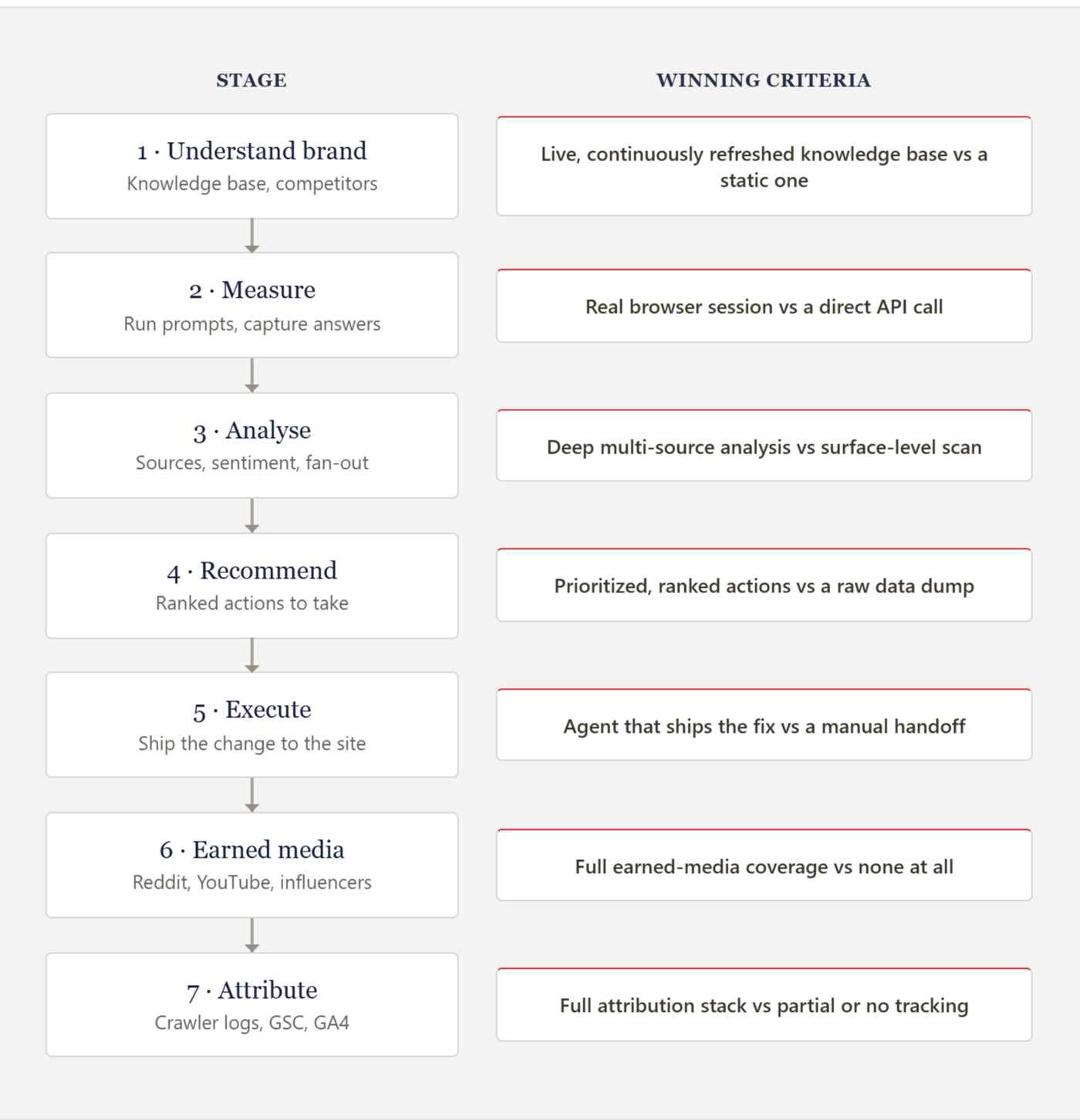
Here is what each one actually means, and whether it is worth anything.
1. Understand the brand. Learn your products and competitors. Everyone can do it.
2. Measure. Ask the models the real questions, record who they mention. Every demo shows this. In a year it costs nothing.
3. Analyse. Which sources the model used, who took your place. Still a report.
4. Recommend. Tell the brand what to fix. Nobody renews a contract for advice.
5. Execute. Make the change instead of suggesting it. This is the line between a report and a product.
6. Earned media. Get mentioned where models read: Reddit, YouTube, reviews, creators. One study of 25 million citations found only 14% pointed to a brand's own site. Hardest to do, hardest to copy.
7. Attribute. Prove an AI answer brought a real customer. Messy, boring, unsolved, and the number a CMO needs to keep the budget.
The first four will become cheap. The last three are where a real company lives. If I have to choose one, I choose the boring one: attribution. Whoever proves the answer created the customer sets the price for everything else.
The pattern is familiar from the last cycle. The dashboard gets commoditized. The workflow gets paid.
What I would take away
If you run a brand: your customers are already asking a model about your category, and you have no idea what it answers. Go ask it yourself, in your own market, logged out. That answer is your real shelf position.
If you are building here: the dashboard is not the business. Everything defensible sits after the measurement.
If you are investing: ask the boring questions first. Do they measure from the API or from the real interface? Can they pin it to a country and a language, or is everything US English? Do they tell the brand what to fix, or do they fix it? And what is left of the company when measurement becomes free? If the answer is the dashboard, this is not a company. It is a feature waiting to be absorbed.
And to be fair: search is not dead. Google still handles the majority of queries, most purchases still end on a website, and this shift is uneven — simple informational questions are going first, big considered purchases much slower. One tab count in one meeting room is a leading indicator, not a verdict.
But noticing leading indicators is the job.
