
Traditional Businesses Can Be VC-Backed
Sometimes, we get stuck in old beliefs about certain models, markets, or even founders. I think it is important for venture capitalists not to become too attached to their beliefs, but instead to adapt to change.
A successful company can emerge in a market that we previously held strong negative beliefs about by doing something different from the other, seemingly infinite, startups we have historically come across in that sector. Those companies may have shaped our perception of the market, but that does not mean our perception should remain unchanged.
A founder we once believed was unbackable might, after some time, have evolved, learned from their mistakes, and eventually succeeded. The same narrative can apply to business models as well.
A few months ago, I met a startup whose entire model depended on hiring real-estate brokers and coupling them with AI to increase their productivity. I was initially against the model because my immediate reaction was: this is a traditional business. You are essentially building a brokerage company, and that is not VC-backable.
So, I waved it away.
Then, a colleague in the ecosystem shared an article by Julien, a Sequoia partner, titled Services: The New Software. From there, my interest in this model evolved.
So, let's start from the beginning: What is this model all about?
The idea is to build a hybrid model (AI + human), sometimes referred to as "Agentic Firms" or AI-first/AI-native service companies. Professionals deliver the service to the end customer, while AI does the heavy lifting. The professional then reviews and edits the output if necessary before delivering it to the customer.
Let's take the legal sector as an example.
A company operating under this model would essentially be a law firm. It receives a request from a client to draft a Master Services Agreement (MSA). The AI produces the initial draft of the MSA, the lawyer reviews it and makes amendments if necessary, and then shares the final document with the customer.
The customer can receive the final document within a few hours rather than days or weeks when dealing with a traditional law firm.
These firms usually charge a fixed fee per outcome, in this case, per contract, which is typically lower than the billable-hours model used by traditional law firms.
These two components, speed and cost, make it plausible for customers to use agentic law firms.
So, what makes this model attractive for investors?
First: Tapping into a bigger TAM
Compared to pure technology products, agentic firms deal directly with the end customer. Pure software companies, on the other hand, often serve the firms that ultimately serve the end customer.
Take Harvey and an agentic law firm such as Crosby as an example.
Crosby serves growth companies directly and allows them to outsource their legal work entirely to Crosby, which delivers the final outcome. In another scenario, these companies might need to build an in-house legal team to perform the work, and that team might use Harvey to increase its productivity.
Unlike Crosby, Harvey is a legal-tech company that provides AI-powered software to law firms and in-house legal teams to increase their productivity and help them deliver outcomes to their end customers.
This means Harvey competes for the software budget, while Crosby competes for the labor budget. The labor budget can be significantly larger because a company may not need to maintain an in-house legal team if it can outsource the entire function to Crosby.
This is the theoretical part. Let's translate it into numbers.
Let's compare the two markets: the market Harvey is playing in, Legal AI, and the market Crosby is playing in, Agentic Law Firms.
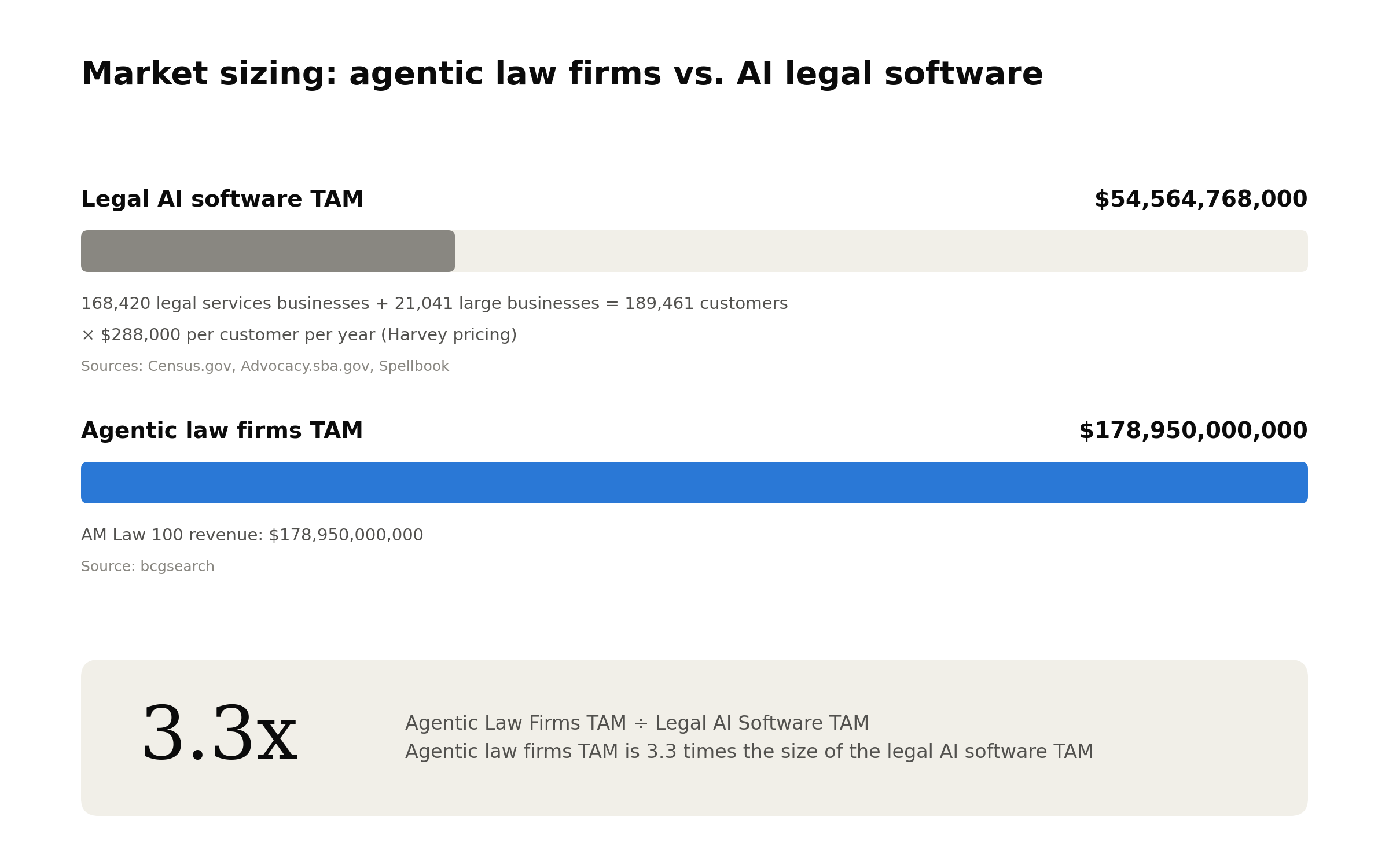
As illustrated in the image below, the total number of legal services businesses and large businesses in the US, the customers Harvey is targeting, is around 189K. Multiplying that by their pricing of $288K per year gives us approximately $55Bn in TAM.
Huge, right?
Now let's look at the agentic law firms market.
The revenue of only the largest 100 law firms in the US, most of which serve businesses similar to Crosby's target customers, is $179Bn. And this is not the entire market; it represents only the largest 100 firms.
Even using just this portion of the market, it is still 3.3x larger than the Legal AI software market.
So, what made this market not VC-backable for so long?
That leads us to the second point.
Second: Scalability
What historically made law firms and other professional services businesses difficult to back with VC was their scalability.
To scale in these markets, you historically needed to proportionally hire more professionals to grow your revenue. This is expensive and slow.
But what happens when you add AI?
Instead of one lawyer handling 10 customers, what if a lawyer can now handle 100 customers?
In that case, revenue growth does not require a linear increase in the number of lawyers.
People (and I was one of them) usually put too much weight on the human component and tie the entire scalability question to the idea that, for the business to grow, it will need to continuously hire more people to deliver the work.
What they miss is that scaling these businesses does not necessarily require a linear increase in headcount.
And that is the key distinction between agentic service companies and traditional service companies.
What should we look for when analyzing these hybrid-model companies?
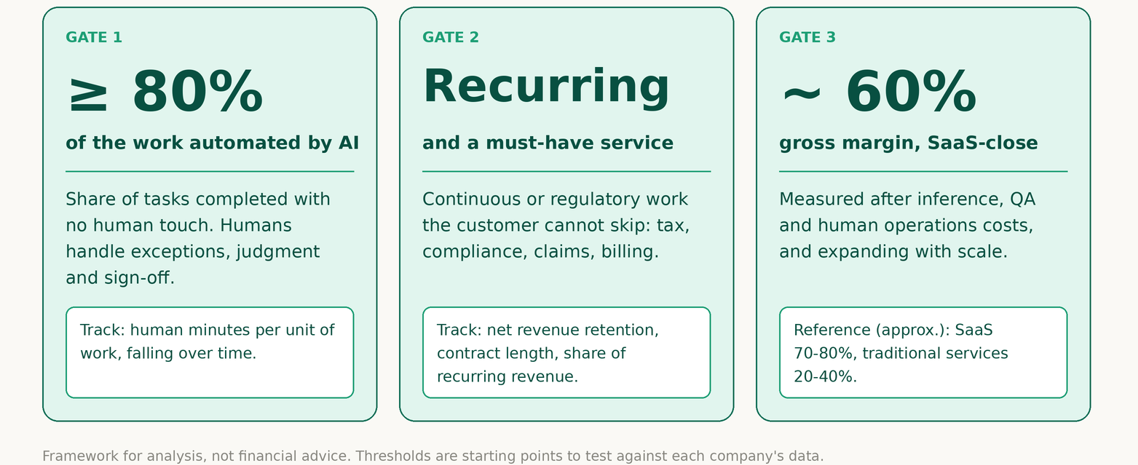
First: AI should really be doing the heavy lifting
The AI should be responsible for the majority of the work, ideally around 80%.
This can be measured by looking at the time it takes to deliver the work, or what is commonly referred to as turnaround time (TAT). In Crosby's case, for example, this is 58 minutes.
Second: The service should be a must-have and recurring
The services offered should be essential rather than nice-to-have, and they should be recurring rather than one-off.
In Crosby's case, legal work is recurring for growth companies that target enterprises as customers. These companies continuously need legal work as they sign customers, hire employees, raise capital, and operate their businesses.
Third: Close-to-SaaS margins
Since these companies rely less on human labor, the human cost as a percentage of revenue should decrease over time, allowing margins to approach SaaS levels, around 60%.
This is important because it provides another indication that AI is actually doing the heavy lifting.
The bigger lesson
The most important thing I learned from this experience, beyond learning about this interesting model itself, is that it is not healthy for VC investors to become stuck in their beliefs.
We work in a business that requires us to adapt to change. We usually associate this change with new technologies, but change can come through different areas and aspects of a business. Business models are one of them.
Keeping an open mind to these changes, understanding them, and then applying the core principles of venture capital — huge markets, scalability, and attractive margins — before making a judgment and closing the door could help us avoid missing good opportunities.
The lesson for me was not that every traditional business can become VC-backable.
It is that we should not reject a business simply because it does not fit the pattern we have historically associated with VC-backed companies.
Instead, we should ask whether the underlying economics have changed.
And sometimes, AI can change them.
Finally, if you're a founder building a company with this model, please DM me. I'd be happy to chat about it.
