
Part 2: The Syntax Ceiling: Is “English.exe” Throttling the AI Reckoning?
In my last piece, I talked about the Three Waves of Quantum, the moment hardware finally catches up to our ambitions. But as we prepare for that compute explosion, we’re ignoring a quieter bottleneck: the language we use to build the "brain" itself.
Right now, we are running a Ferrari engine on low-octane fuel.
Almost every line of code on earth is a derivative of English. We’ve mistaken English’s global dominance for logical superiority. But English is "thin." It’s a linear, "one-word-at-a-time" system that relies on a lot of filler. When we translate a complex human idea into Python or C++, we are sanding down the edges of our thoughts to fit through a narrow 20th-century pipe.
The Logic Arbitrage: Why Some Languages are Just Better Built
The next "alpha" won't come from more English-centric wrappers. It will come from linguistic structures that are actually built like software. While we’ve been optimizing compilers, we’ve ignored the instruction set of the human mind.
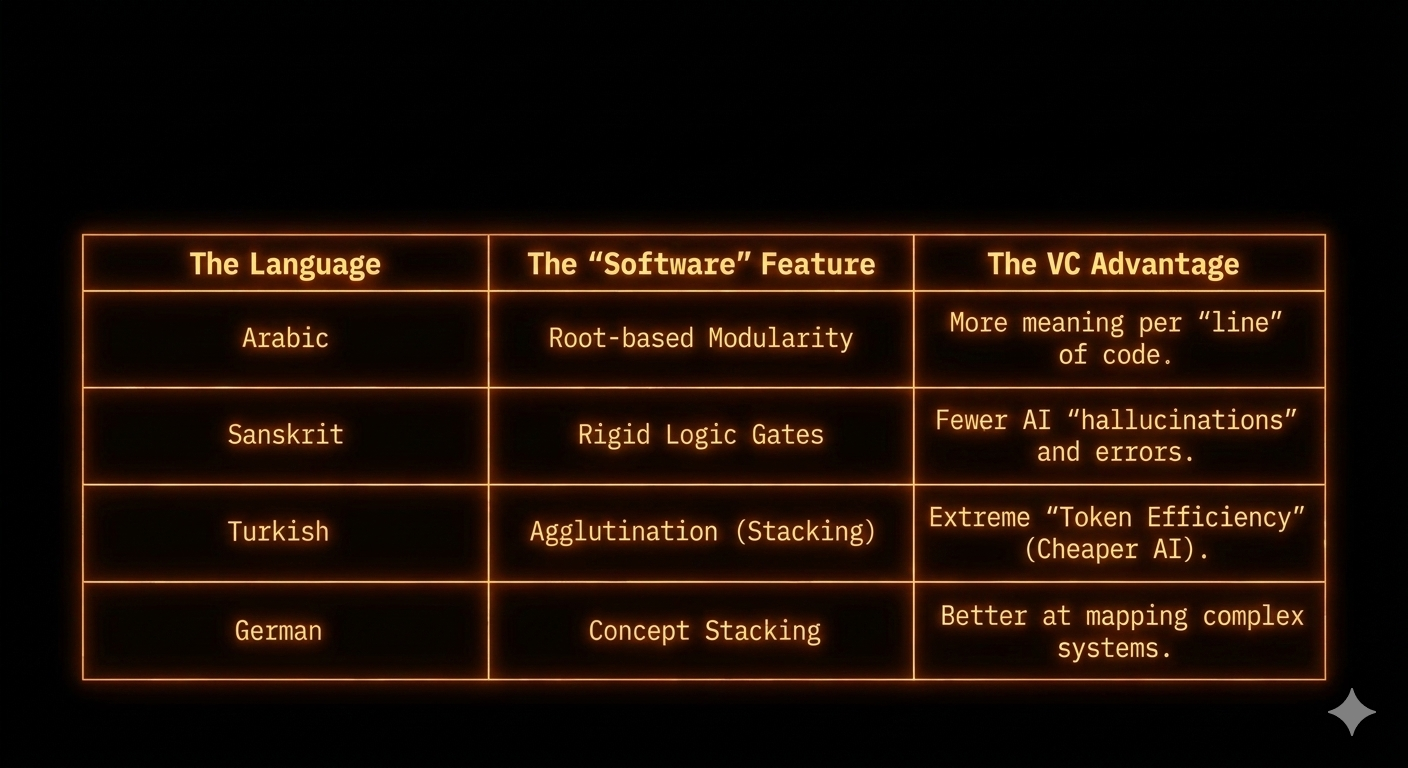
Arabic (The Original "Object-Oriented" Language): Arabic works like a built-in search engine. Almost every word is grown from a 3-letter "root" (like K-T-B for anything related to writing). You don't just learn words; you learn a mathematical matrix. Because every word carries its "parent" logic with it, the language is modular by default.
Sanskrit (The Bug-Free Grammar): Back in 1985, NASA researchers pointed out that Sanskrit’s grammar is so strict and mathematical that it functions like a logic gate. It eliminates the "fuzzy" double-meanings of English, making it a natural fit for code that can’t afford to fail.
Turkish (The Lego Set of Languages): Turkish is "agglutinative", meaning you glue suffixes together to build massive meaning. Where English needs a whole sentence, Turkish often needs just one word. It’s the ultimate form of data compression.
German (The System Thinker): German fuses concepts into hyper-specific "System-Words." It doesn't just describe a process; it turns the process into a single, dense noun. It’s a language built for mapping complex architectures.
The “Token Tax”
When AI models (LLMs) talk to each other, they don't use English sentences. They communicate in "vectors", dense clusters of math. This math is actually much closer to the "root" system of Arabic or the "word-stacking" of Turkish than it is to English.
By forcing AI to talk to us in English, we are imposing a Cognitive Tax. We’re making the model do extra work to "decompress" our thin, linear logic into its dense reality. We are paying for more "tokens" (the units AI reads) just because English is leaky and inefficient.
The Qalb Lesson: Our Digital “Legacy Debt”
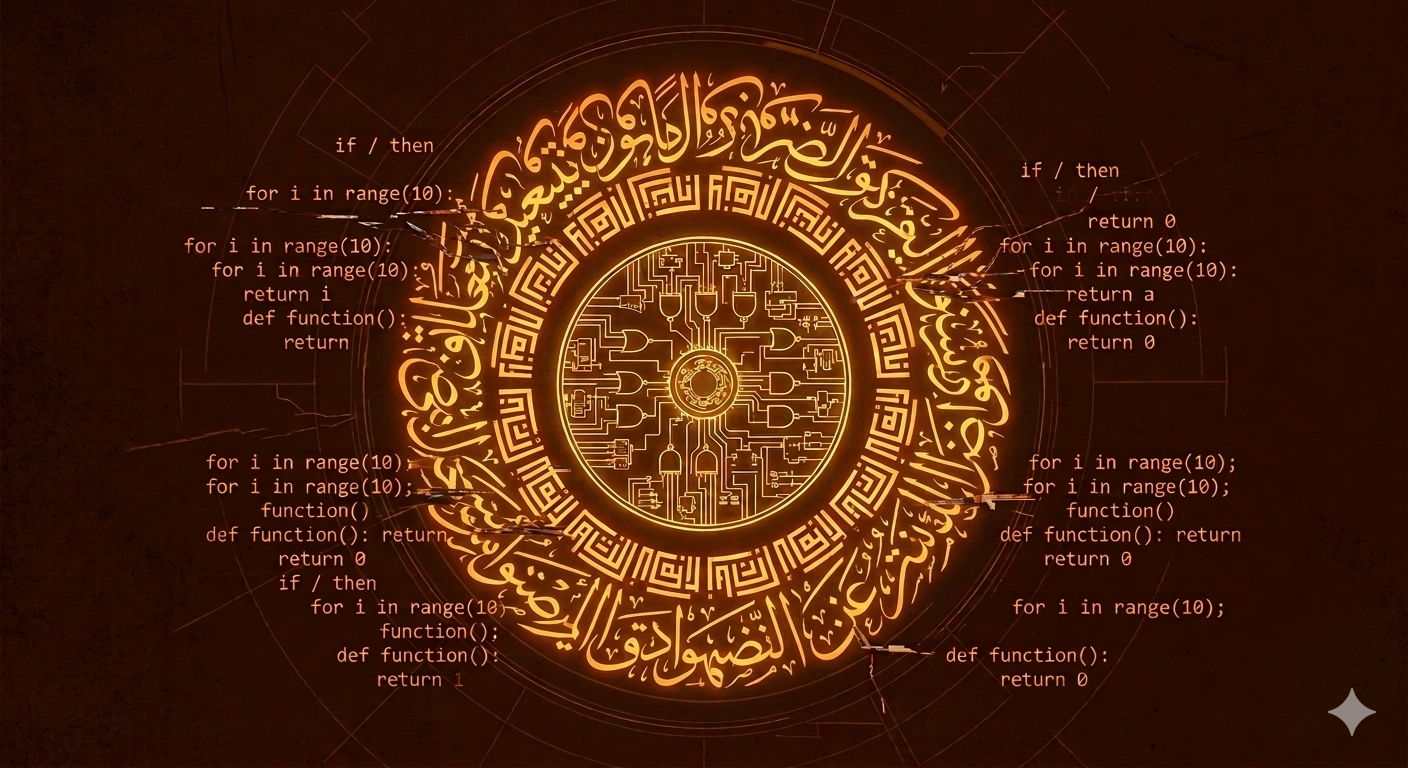
This isn't just theory. Look at Qalb (قلب), an Arabic programming language. It proved you could write foundational math in a beautiful, calligraphic matrix where logic and art were the same thing.
But Qalb also exposed a huge problem: Infrastructure Debt. Qalb code often breaks on modern platforms, not because the logic is wrong, but because the entire plumbing of the internet, from the way your keyboard works to how GitHub stores files, is hard-coded for English. We have built a digital world that literally cannot "read" some of the most logical languages on Earth.
The Saudi Tech Edge: Beyond “Translation”
This isn't just a theoretical shift; it’s a structural opening for the MENA ecosystem.
In the regional tech scene, "localization" is often treated as a final coat of paint, translating buttons from Left-to-Right. But from an investment perspective, that’s leaving money on the table. If Arabic’s root-based structure is a fundamentally superior logic for AI, then simply translating Silicon Valley’s models is a waste of a massive competitive advantage.
The real opportunity is in Linguistic Engineering.
The next generation of founders in Riyadh won't just be localizing existing tech; they will be the ones leveraging the modularity of their own language to build more efficient, "token-dense" models from the ground up. In the race for compute efficiency, that’s not just culture, it’s a competitive advantage.
The “Creative” Curse
But if we have the better "logic," why hasn't the market reflected that yet? Why does a "lesser" language like English continue to dominate the unicorn charts while more sophisticated linguistic cultures struggle to scale?
Coming Next: We’ll look at the "Creative Curse" and why a 10/10 brain in a 1/10 capital ecosystem loses every time.
The reckoning continues.
Written by Alyaqootah Khaled