
From Selling Software to Selling Work
Our focus is evolving
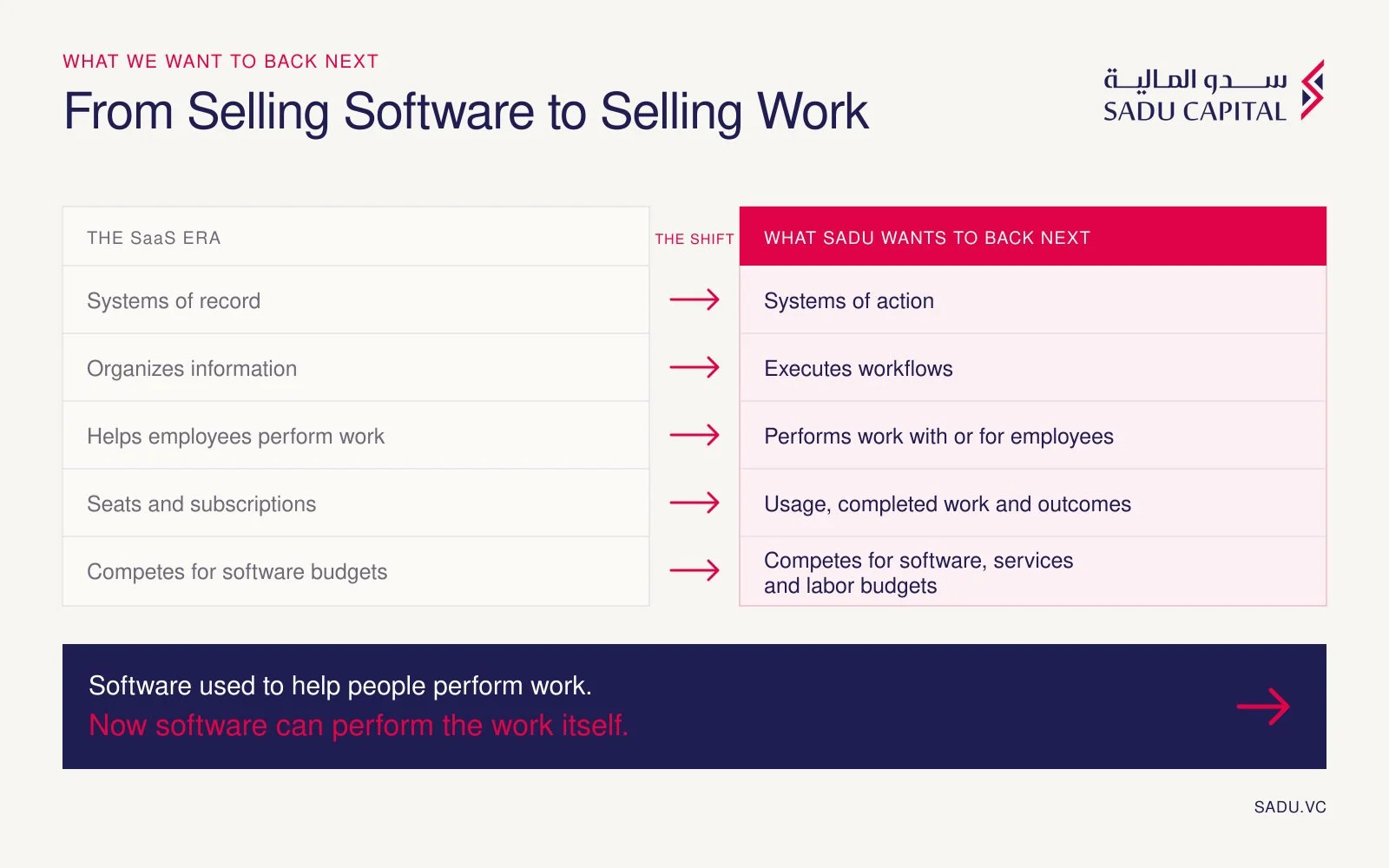
Software no longer only helps people do work. Increasingly, it does the work itself.
For years, Sadu Capital backed software that digitized work: systems of record that moved customer, financial and operational data into the cloud and gave employees better tools. We will continue to back exceptional SaaS companies, but selectively.
Our primary focus is now companies that deliver work, not just software to manage it. We have already started, with portfolio companies such as OpenCX and OCTA.
The idea is no longer new. Over the past year, "selling work, not software" has become one of the most widely shared theses in global venture, and outcome-based pricing has gone mainstream in categories like customer support. We are especially interested in companies built around work specific to MENA: Arabic language, local regulation and the region's document-heavy industries.
Here is how we think about the category, and what we want to see from founders building in it.
What we mean by selling work
The customer is no longer buying access to a tool. The customer is buying work completed.
We look for companies that can name the job they perform and the output they deliver. Not a vague promise to "increase productivity," not a chatbot added to an existing interface, and not an AI feature looking for a problem.
The output should be something a customer can count:
An account reconciled
A customer request resolved
A contract reviewed
A claim processed
A lead qualified
A permit filed
A compliance check completed
OpenCX does not simply help an agent manage tickets; it resolves customer requests. OCTA does not simply organize financial data; it reconciles accounts, prepares reports and follows up on collections.
Companies may start as copilots that assist people. Over time, they should move toward supervised agents and, where reliability allows, autonomous execution. What matters is that the share of the workflow they own keeps growing.
Where we're focused
We are focused on areas where AI can take on real work, especially where regional knowledge gives founders an edge:
Arabic-first customer operations: voice agents, support resolution, contact-center automation and quality assurance, built for Arabic dialects and local service expectations.
Government, regulatory and legal workflows: permits, filings, contracting, document review and high-volume case processing, shaped by each country's regulation and institutional practice.
Financial and revenue operations: reconciliation, reporting, collections, compliance and revenue operations, including local tax, e-invoicing and reporting requirements.
Healthcare administration: patient access, clinical documentation, coding, scheduling and claims, across bilingual documentation and local payer rules.
Construction, real estate and facilities: estimating, project controls, inspection, leasing and maintenance in some of the region's largest, most document-heavy industries.
Logistics, procurement and supply chains: purchasing, routing, trade documentation, vendor coordination and exception handling across fast-growing regional trade.
Cybersecurity, risk and fraud: AI-native systems that monitor, investigate, prioritize and remediate threats, built for local data-sovereignty and compliance requirements, with clear permissions and human oversight.
Other categories: we will also look at exceptional companies in software development, people operations, sales and marketing operations, and corporate AI infrastructure.
Robotics and physical AI: still an emerging category in the region, so we will be selective and favor deployment and application-layer companies in industrial, logistics and facilities settings.
What we look for
Using AI is not, by itself, an investment thesis. When we meet a founder in this category, these are the questions we ask.
Identifiable work. What job does your product perform, and who performs it today? We want a clearly defined job, not an ornamental AI feature.
Measurable output. What output does the customer care about, and can they verify it was delivered?
Recurring demand. How often does this work happen, and how much time and money does it consume today?
Improving economics. Why will revenue grow faster than the human cost of delivery, and how do margins improve as models improve?
Controlled autonomy. How much of the workflow do you execute now, what still needs a human, and how do you catch and handle errors?
A compounding moat. What becomes more defensible as you perform more work? Access to the same foundation models as everyone else is not enough.
The best founders here understand both software and operations. They know where AI should act alone, where a human should stay involved, and how that line should move over time. Most of all, we want to see the product working.
Where we stand on the open questions
As this thesis has gone mainstream, so have its weak points. Founders should know how we view them.
Pricing. We favor companies that price on work completed or outcomes delivered, or are clearly moving there. A company that says it sells work but charges per seat is usually still selling a tool. We are pragmatic about hybrid models in the early years.
Reliability. The hard part is not the demo; it is the last 10% of cases. We want to see how the product handles exceptions, how errors are caught and what happens when it fails.
Revenue quality. Some "AI revenue" is consulting work billed as a subscription. Early implementation work is fine and often necessary, but services effort per customer should fall as the product matures.
Value capture. When AI replaces labor, customers rarely pay software the full cost of that labor. Founders need a clear view of how much of the savings they can keep, and why that share holds as competition grows.
AI-enabled services firms. Some founders run services firms on their own AI; others acquire existing firms to transform them. We are open to the first when the technology is the core of delivery. We are cautious about roll-ups where the acquisitions do more of the work than the software.
Consumer technology
We will keep backing differentiated consumer technology and consumer AI, without forcing it into a "selling work" frame. The bar is the same: a meaningful problem, a differentiated product, strong founder insight and the potential to build an enduring company.
From selling software to selling work
The SaaS era created enormous value by giving people better tools. The AI-native era lets technology companies address labor and services spending, not only software budgets.
That shift is now visible everywhere. Our focus is where it meets MENA's languages, regulation and scale of ambition.
If you are building a company that does not merely help people work, but increasingly delivers the work itself, we would like to hear from you. Reach us at sadu.vc.
